Introduction
Every ride at Disneyland Resort has a strategy. Radiator Springs Racers has a religion.
I have never met a guest who rode it once and did not immediately want to ride it again. I have never met a guest who waited 90 minutes for it on standby and thought the wait was too long. And I have never given DCA advice without putting this ride at the center of the entire day plan.
Radiator Springs Racers is the most popular attraction at the entire Disneyland Resort — not just DCA. On any given day it has the longest or second-longest wait of any ride at either park. The $200 million investment Disney made building it in 2012 produced the most consistently demanded theme park attraction in California fourteen years later. The 2025 refurbishment — LED show lighting, resurfaced track, enhanced audio and video throughout — has the ride running in the best condition of its life.
This guide covers everything: what the ride actually does, the three queues and how each works, the current wait time reality for the rest of 2026, how to use Single Rider to cut a 90-minute wait to 20 minutes, Lightning Lane strategy, night riding, Cars Land, and what to do when the ride breaks down mid-queue.
If you are planning a DCA visit and Radiator Springs Racers is not the first thing you think about in the morning, you have not read this guide yet.
Part 1 — What Radiator Springs Racers Actually Is
The Ride in Plain English
Radiator Springs Racers is two rides in one. The first half is a slow, beautifully themed dark ride. The second half is a genuine outdoor race at 40 miles per hour.
Your vehicle — a six-passenger car styled after the Cars film's Route 66 aesthetic — departs from the Comfy Caverns Motor Court loading area and begins a leisurely drive through Ornament Valley. The canyon scenery around you is the same Cadillac Range butte landscape you walked through in Cars Land. A towering waterfall falls past your vehicle. The scale of the outdoor canyon section in the early portion of the ride is genuinely surprising to first-timers — the environment feels enormous.
The ride transitions into Radiator Springs at night. You dodge an angry combine harvester. You pass through Ramone's House of Body Art or Luigi's Casa Della Tires — the assignment is random and determines which race prep sequence you experience. One group gets Ramone's neon paint job. The other gets Luigi's tire change. Both are excellent and have distinct character interactions and scenes.
After the race prep, your vehicle pulls alongside a competing car carrying another group of riders. A countdown. And then both cars launch simultaneously into the outdoor racing circuit.
The outdoor race covers camelback hills, banked curves, and canyon underpasses at 40 mph — not the fastest ride at the Resort (Incredicoaster at 55 mph holds that), but fast enough with enough lateral movement and air time to feel genuinely thrilling. The race winner is randomly determined. Your car might win, might lose. Cheering anyway is mandatory.
The ride ends after a pass through the glowing Tail Light Cavern with Lightning McQueen and Mater delivering parting words. Total ride time: approximately 4.5 to 5 minutes.
The 2025 Refurbishment — What Changed
The September 2025 refurbishment upgraded Radiator Springs Racers in three meaningful ways:
LED show lighting throughout the indoor scenes. The Radiator Springs at night sequence — the portion between the outdoor canyon approach and the race launch — was entirely relit with LED show lighting. The neon and ambient light effects are now significantly richer than the original installation. The indoor scenes look better than they ever have.
Resurfaced track. The racing circuit was resurfaced, eliminating the lateral roughness that had developed in certain sections. The outdoor race now runs noticeably smoother than it did in the years before the refurbishment.
Enhanced audio and video. The character animatronic audio and screen sequences in both the Ramone's and Luigi's prep rooms were updated. The character performances are cleaner and the audio sync is tighter.
The result is a ride that opened in 2012, has been running continuously for fourteen years, and is operating in the best condition of its existence. First-timers are experiencing the best version of Radiator Springs Racers that has ever been available.
The Ride Vehicle
Six passengers per car, three seats across — two rows. Each seat has its own seatbelt: the two outer seats carry lap and shoulder belts, the middle seat has a lap belt. Each seat has a headrest and hand bars to grip during the race.
The vehicle sits low to the ground with enclosed sides and your feet touching the vehicle floor — bucket seat configuration similar to a sports car. The vehicle has on-board audio that syncs with the music during the race. Your car and the competing car are both attached to track — large-scale slot cars — which means the actual race outcome is controlled, not dependent on physics.
Height requirement: 40 inches minimum. No upper height restriction but taller guests note limited knee room in the vehicle.
Accessibility: Wheelchairs and ECVs enter through the regular queue. Riders must be able to transfer to the vehicle. A separate loading area for guests needing extra time is available — ask a cast member.
Part 2 — The Three Queues
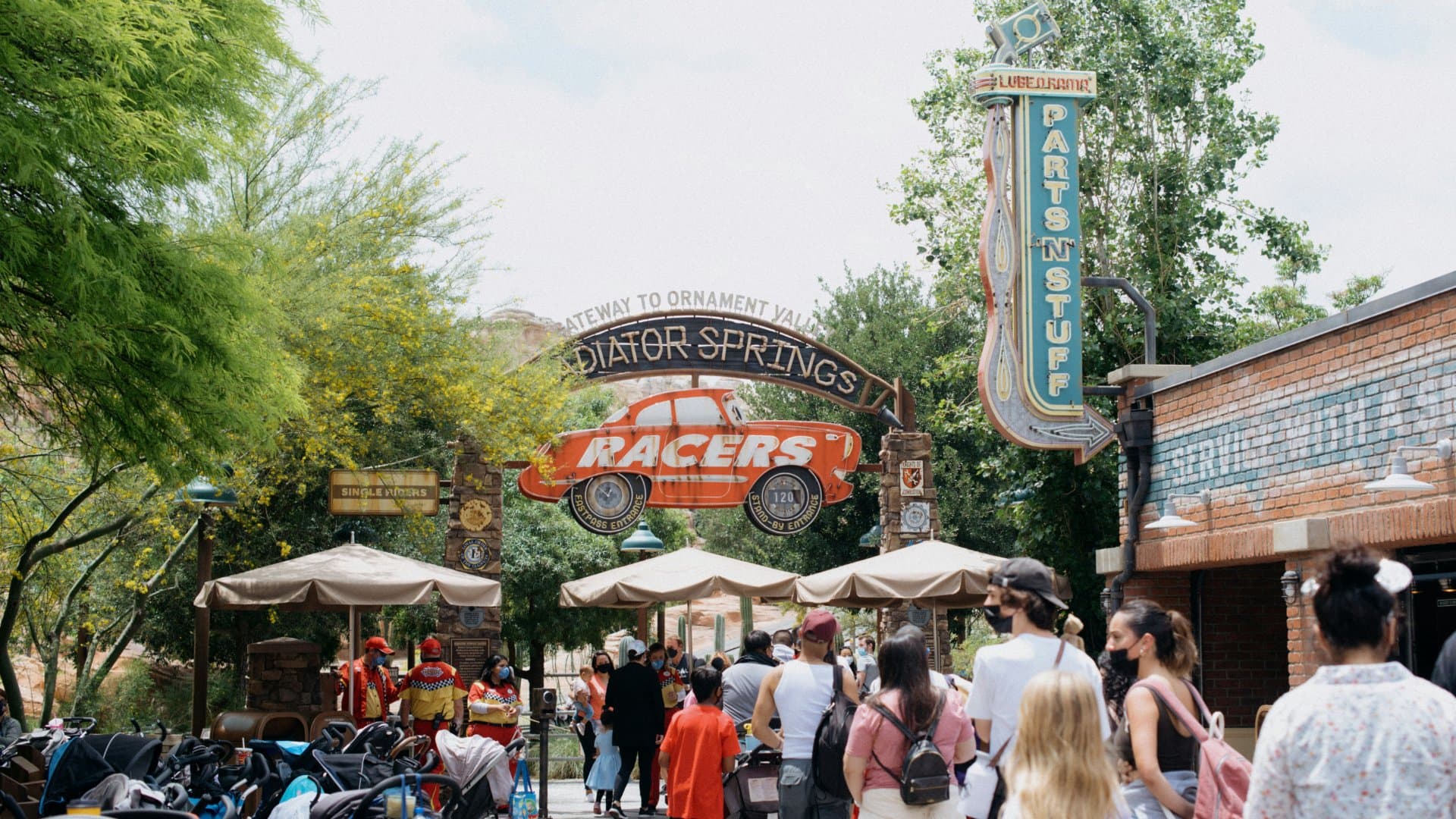
Radiator Springs Racers has three separate entry queues that merge shortly before the loading area. Understanding which queue to use is the most consequential strategic decision for this ride.
Queue 1 — Standby
The standard queue. The longest wait. The most complete experience.
The standby queue passes through the full narrative of the ride's backstory — the story of Stanley the radiator cap salesman who founded Radiator Springs, the famous spring itself, the Amazing Oil Bottle House, Stanley's Cap-n-Tap. The queue winds through shaded canyon sections and past elaborately themed storefronts. The Imagineers built this queue knowing guests would be waiting in it for a long time — it is among the most detailed and scenic queues at either park.
If you have never ridden Radiator Springs Racers and are willing to wait, the standby queue gives you the complete pre-ride environment that neither the Single Rider nor Lightning Lane queues provide. One standby ride for the queue experience, then Single Rider or Lightning Lane for subsequent rides, is a legitimate approach on a first visit.
Current wait time reality for the rest of 2026:
We are in summer now — June 22, 2026. Here is what the rest of the year looks like:
June through Labor Day (now through September 1): Peak summer crowds. Standby for Radiator Springs Racers runs 70 to 110 minutes from park open through park close on weekdays. Weekends run 90 to 120 minutes from mid-morning onward. The only standby windows worth considering are the rope drop 20-minute window before the line builds, and the final 45 to 60 minutes before park close when some families have exited.
After Labor Day through October (September 2 through October 31): Halloween Time at DCA runs concurrently with lower summer crowds. This is when Radiator Springs Racers becomes more accessible on standby — weekday waits drop to 45 to 70 minutes in the afternoon on moderate crowd days. Rope drop standby runs 20 to 30 minutes as usual.
November through Thanksgiving (November 1 through 23): One of the best windows of the year. Weekday standby runs 30 to 55 minutes in the mid-morning, dropping further in the afternoon. Schools are in session, summer has ended, and DCA runs at moderate crowd levels.
Thanksgiving Week (November 24 through 30): Peak crowds return. Standby runs 80 to 120 minutes. Single Pass or Single Rider required for any reasonable experience.
Early December (December 1 through 18): Holiday season begins. Moderate to elevated crowds. Standby runs 55 to 80 minutes on weekdays, higher on weekends. Single Rider and Single Pass remain the efficient options.
Late December (December 19 through January 1): Maximum holiday crowds. Standby runs 90 to 120+ minutes from park open. The longest consistent waits of the year.
The standby rule: On any day in the peak summer or holiday windows, standby for Radiator Springs Racers beyond the rope drop window is a poor use of your time. The Single Rider line and Lightning Lane Single Pass exist precisely for this situation.
Queue 2 — Single Rider
The most important strategy tip in this entire guide stated simply: if you are willing to split from your group, use the Single Rider line.
The Single Rider queue at Radiator Springs Racers fills empty seats in partially filled ride vehicles rather than loading complete groups. The result is a wait time that consistently runs 60 to 80 percent shorter than standby — and on peak days the gap is even wider.
Current Single Rider wait reality:
Peak summer weekday: 20 to 35 minutes while standby runs 80 to 110 minutes
Peak summer weekend: 25 to 45 minutes while standby runs 90 to 120 minutes
Moderate fall/spring weekday: 15 to 25 minutes while standby runs 40 to 70 minutes
That gap — 25 minutes versus 100 minutes on a busy summer day — is the most consequential wait time differential at either park. During spring break 2026, standby averaged 100 minutes while Single Rider ran 20 to 30 minutes. The pattern holds across all peak periods.
What you give up with Single Rider:
The Single Rider queue bypasses the standby narrative queue and proceeds more directly toward the loading area. You will experience less of the pre-ride environment than a standby rider.
More significantly: in the Single Rider queue, your group is split up and seated separately in different vehicles. You will not sit together. You will not race against each other. If riding alongside your family or group is important to your experience, Single Rider is not the right choice. If you care primarily about experiencing the ride and are comfortable splitting up, Single Rider is the most efficient option available.
The Rider Switch interaction with Single Rider: If your group includes a child who does not meet the 40-inch height requirement, you can use Rider Switch in combination with Single Rider. The waiting parent receives a Rider Switch pass that functions as Lightning Lane access — they do not need to use Single Rider separately.
Queue 3 — Lightning Lane Single Pass
The fastest boarding option. The most expensive. The one that allows your full group to ride together.
Lightning Lane Single Pass for Radiator Springs Racers has no published base price — prices vary by date and attraction. Check the Disneyland app for the current price on the day of your visit.
How to purchase: You must be inside the DCA gates before you can purchase Single Pass. The moment you scan your ticket at the park entrance, open the Disneyland app, navigate to Lightning Lane, and purchase the Single Pass for Radiator Springs Racers. Return time windows are assigned based on current availability — on peak days, windows push to afternoon quickly and sell out entirely before 9am.
When Single Pass makes sense:
Groups with young children where splitting up is not viable
Families who specifically want to race against each other in competing vehicles
Guests visiting on a single day where every hour matters
Anyone for whom the Single Pass cost is manageable relative to the time saved
When Single Rider makes more sense:
Adults or older children who do not mind splitting up
Any guest for whom the Single Pass cost is a meaningful expense
Groups that plan to ride more than once — Single Rider can be used multiple times per day, Single Pass only once
The combination strategy: Buy Single Pass for one morning ride where your full group rides together. Use Single Rider later in the day for additional rides. This is Mateo's personal default for any DCA day.
Part 3 — Wait Time Strategy by Current Date
We are at the beginning of summer 2026. Here is the specific timing strategy for the remainder of the year.
Now Through Labor Day — Summer Strategy
Rope drop is the only reliable standby window. Arrive 45 to 60 minutes before official park opening. Be through bag check and positioned at the DCA entrance before the park opens. Walk directly to Cars Land the moment the rope drops. The standby queue at rope drop runs 20 to 30 minutes — sometimes less if you are among the first riders. By 9:30am on a summer day, standby has crossed 60 minutes. By 10:30am, it is 80 to 100 minutes.
Single Pass is essential on summer weekends. Purchase the moment you enter the park. On summer weekends, the Single Pass for Radiator Springs Racers can sell out by 9am and return windows push to late afternoon by mid-morning. If you are visiting on a summer Saturday or Sunday, treat the Single Pass purchase as the first and most urgent action of the day.
Single Rider is your best mid-day option. Between 10am and 6pm on summer days, Single Rider consistently delivers the best time-to-ride ratio of any queue option. The 25 to 40 minute Single Rider wait versus 90 to 110 minute standby is the single most impactful strategic decision available at DCA.
Evening standby drops slightly but not dramatically. The 9pm standby during summer runs approximately 60 to 70 minutes based on recent data — meaningfully lower than the 90 to 110 minute afternoon peak but not the near-walkup some guests expect. The final 30 minutes before close produces the lowest evening waits as guests exit for parking. If you are in the standby queue when the park closes, you can remain in line until you ride.
The post-World of Color surge. After the first World of Color show ends — typically around 9pm — a portion of the crowd races to Radiator Springs Racers for a final ride before close. This surge briefly spikes the standby line and slows the Single Rider queue. If you want to ride in the final hour, position in the Single Rider queue before World of Color ends rather than after.
September — The Best Window of the Rest of 2026
After Labor Day, schools return to session and DCA's crowd levels drop meaningfully. September is the most underrated month to visit DCA and specifically one of the best months for Radiator Springs Racers access.
September weekday standby: 30 to 55 minutes from mid-morning through early afternoon. This is the most manageable standby window available outside of rope drop and it only exists in September and early November.
September weekend standby: Still 60 to 80 minutes at peak hours but meaningfully lower than summer weekends.
Single Rider in September: 10 to 20 minutes on most weekdays. The most efficient and relaxed Radiator Springs Racers experience of the entire year runs in September on a midweek day.
October — Halloween Time Crowds Return
Halloween Time brings visitors back to DCA through October and Radiator Springs Racers waits climb back toward summer levels on peak days. Columbus Day weekend (October 13 to 16) produces significant crowd spikes.
October weekday standby: 50 to 75 minutes at peak hours.
October weekend standby: 70 to 100 minutes.
Single Rider remains the right choice on most October days. Single Pass is worth purchasing on October weekends.
November 1 Through 23 — Another Sweet Spot
The stretch from Halloween through Thanksgiving produces some of the best Radiator Springs Racers access of the year. Schools are in session, summer visitors are gone, and DCA runs moderate crowd levels that make the ride genuinely manageable.
November weekday standby: 25 to 50 minutes. Rope drop waits can drop to 15 minutes on light-crowd November weekdays.
November weekend standby: 55 to 80 minutes.
Thanksgiving Through Year End
Thanksgiving week, late December, and New Year's return to peak conditions. Standby runs 80 to 120 minutes. Single Pass and Single Rider are essential. Same strategy as summer.
Part 4 — Night Riding
This is the part most guests miss and it is worth specifically planning for.
Radiator Springs Racers at night is a meaningfully different experience from the daytime ride. The outdoor racing circuit — the portion that runs through Ornament Valley and around the canyon buttes — transforms after dark when the Cars Land neon lighting activates along the main street and the Cadillac Range buttes are lit against the dark sky.
The race at 40 mph through a canyon lit by Route 66 neon is one of the most visually cinematic moments available anywhere at the Disneyland Resort. The outdoor lighting at night makes the buttes feel bigger, the speed feel faster, and the environment feel more alive than the daytime version.
The ride photo — taken during the indoor portion — is also better at night when the LED show lighting in the Ramone's and Luigi's scenes produces more dramatic contrast than the daylight exterior.
When to ride at night: The Cars Land neon activates approximately 30 to 45 minutes before sunset. In summer (now through August), that means after 7pm. In fall and winter, progressively earlier. Check sunset time for your specific visit date.
Night ride strategy: Use your Lightning Lane Single Pass for the afternoon ride if you purchased it for timing convenience. Save your Single Rider ride for after dark when the neon is active. The Single Rider queue in the evening after World of Color (but before the post-show surge) is often shorter than midday.
Part 5 — The Queue in Detail — What to Look For
The standby queue for Radiator Springs Racers tells the story of Stanley, the radiator cap salesman who founded Radiator Springs, before you ever board the ride. Most guests walk through it focused on their phone. These are the things worth slowing down for.
Stanley's Oasis: The first major section of the queue recreates the original desert oasis where Stanley's radiator spring was discovered. The spring itself is visible — a practical water feature with real flowing water — surrounded by period-accurate frontier architecture.
The Amazing Oil Bottle House: A home built entirely from oil bottles, visible from the queue path. The detail in the construction — individual glass bottles mortared together — is a piece of Imagineering craft that rewards a close look.
Stanley's Cap-n-Tap: The storefront where Stanley sold radiator caps before establishing the town. The period signage, the window displays, and the architectural detail throughout this section of the queue are extraordinary.
The transition to Radiator Springs at night: As the queue approaches the loading area, the environment transitions from the desert frontier exterior to the Radiator Springs main street at night — neon signs, lit storefronts, and the full Cars Land atmosphere recreated at interior scale. This is when the queue becomes the ride.
Chicken exits: There are two exit points if anyone in your group decides they do not want to ride. The first is at the beginning of the queue — simply turn around and exit the way you entered. The second is at the boarding area — tell the cast member you want to exit and you will be directed to step into the vehicle and immediately step out the other side.
Part 6 — Cars Land — Before and After the Ride
Radiator Springs Racers is the headline attraction of Cars Land but the land itself is worth experiencing independently of the ride. Most guests walk directly to the Racers entrance at rope drop and do not slow down for the environment they are walking through. This is a mistake.
The Cadillac Range: The red rock buttes surrounding Cars Land are not painted walls or projected environments. They are three-dimensional structures built to match the canyon landscape of the Cars films with painted and textured surfaces that read as genuine sandstone formations from every angle. Walk along the base of the buttes and look up. The scale is more impressive than most guests register when they are rushing to the ride entrance.
Cars Land at golden hour: The period approximately 30 to 45 minutes before sunset produces the most photogenic version of Cars Land. The warm directional light hitting the butte surfaces creates the exact visual quality of the film's desert scenes. This is the moment the Imagineers designed the land to be experienced. Do not be on a ride during Cars Land golden hour — be walking the main street and looking at the environment.
Cars Land neon at night: The Route 66 neon sign lighting along Radiator Springs main street activates after sunset and transforms the entire land. The Cozy Cone Motel cone-shaped stands glow. The Ramone's House of Body Art facade lights up. The Flo's V8 Cafe sign illuminates. The whole main street reads exactly as it does in the film at night — and the film's design was itself an homage to the golden era of Route 66 neon. Walking Cars Land main street after 7pm with no agenda except to look at it is one of the most genuinely beautiful things available at the Disneyland Resort.
Cozy Cone Motel: The cone-shaped food stands surrounding the motel parking lot each have a different menu. Walk the full loop before choosing. The chili cone queso and the churro toffee popcorn cone are the standouts. The specialty drinks change seasonally. On a hot summer day, the frozen cone beverages are worth the walk around the lot on their own.
Flo's V8 Cafe: The primary table service restaurant in Cars Land. Classic American diner food — burgers, sandwiches, breakfast plates — in a beautifully themed 1950s auto shop environment. The Cars Land surroundings visible through the dining room windows make this one of the most atmospherically complete dining experiences at either park. Mobile order available.
Mater's Junkyard Jamboree and Luigi's Rollickin' Roadsters: Both Cars Land companion attractions are best experienced immediately after Radiator Springs Racers at rope drop while the area is still quiet. Neither requires Lightning Lane, both have no height requirement, and both together take approximately 20 minutes of combined wait and ride time in the morning window. Completing the Cars Land circuit — Racers, then Mater's, then Luigi's — before 9:30am is achievable on most days.
Part 7 — When the Ride Breaks Down
Radiator Springs Racers is a complex attraction running two simultaneous tracks with multiple vehicle types and elaborate environmental systems. It experiences operational pauses throughout the operating day — sometimes brief, sometimes extended.
If the ride goes down while you are in the queue: Remain in the queue if the outage appears brief. Cast members will announce the status. If the wait for reopening extends beyond your tolerance, you can exit through the return path and speak with a cast member about a return pass. Disney issues return passes for guests who waited in a queue for a ride that went down during their wait. These passes allow Lightning Lane entry upon reopening.
If you purchased Single Pass and the ride goes down: Your Single Pass return window will be honored when the ride reopens. If the ride does not reopen before your window expires, speak with a cast member at any Lightning Lane station — they can extend your window or assist with an alternative.
The end-of-night risk: If you are in the standby queue at park close and the ride breaks down in the final 30 minutes, there is a risk of not riding before the park closes for good. This is the one scenario where being at the front of the Single Rider or Lightning Lane queue rather than deep in standby makes a meaningful difference to your outcome.
Part 8 — Radiator Springs Racers with Young Children
Height Requirement and Readiness
The 40-inch height requirement screens out children who are too young to safely ride the vehicle's restraint system. Children who meet the 40-inch threshold are physically eligible. Whether they are emotionally ready for the ride is a separate question.
What to tell children before the queue:
The ride is gentle in the first half — a scenic drive through the canyon and the Cars Land environment they have been walking through all day. The indoor section has some quick turns and an angry combine harvester that surprises some children. The race finish is genuinely fast and loud.
Most children who have handled Disneyland's Big Thunder Mountain Railroad or Matterhorn Bobsleds are ready for Radiator Springs Racers. The thrill level falls between Big Thunder (gentler) and Indiana Jones (more intense) — closer to Big Thunder with the addition of genuine outdoor speed in the race section.
The Cars knowledge factor: Children who love the Cars films experience Radiator Springs Racers with a specific emotional resonance that non-fan children do not have. Lightning McQueen and Mater appearing throughout the ride produce genuine reactions in Cars fans that make the experience meaningfully richer. If you have a Cars-loving child in your group, this ride is potentially the highlight of their entire Disneyland Resort trip.
Rider Switch
Rider Switch is available at Radiator Springs Racers and is the right approach for families where not everyone meets the 40-inch requirement.
Walk the full group to the ride entrance. Tell the cast member at the entrance you need a Rider Switch. Parent 1 rides with qualifying children while Parent 2 waits with the non-qualifying child nearby — Luigi's Rollickin' Roadsters and Mater's Junkyard Jamboree are directly adjacent and both have no height requirement. After Parent 1 exits, Parent 2 uses the Rider Switch pass to board through the Lightning Lane entrance. Qualifying children who want to ride again board with Parent 2 on the same Rider Switch pass — the second ride doubles the qualifying children's count without an additional wait.
The Rider Switch pass at Radiator Springs Racers functions as Lightning Lane access for the return trip — the same efficiency as a Single Pass boarding without the additional cost.
Quick Reference — Radiator Springs Racers
Category | Details |
|---|---|
Land | Cars Land, Disney California Adventure |
Height requirement | 40 inches |
Ride duration | Approximately 4.5 to 5 minutes |
Top speed | 40 mph (outdoor race section) |
Lightning Lane type | Single Pass only (not included in Multi Pass) |
Single Pass price | Varies by date and attraction — check the app |
Single Rider available | Yes |
Rider Switch available | Yes |
Current summer standby | 70 to 110 minutes (mid-morning through close) |
Rope drop standby | 20 to 30 minutes |
Single Rider summer wait | 20 to 40 minutes |
Best standby window | Rope drop or final 45 minutes before close |
Best months remaining 2026 | September weekdays, November 1 to 23 |
Night riding | Recommended — neon lighting after 7pm transforms the outdoor race |
Post-refurbishment status | Best condition since 2012 opening — LED lighting, resurfaced track |
Mateo's Complete Radiator Springs Racers Day Plan
At park entry: Purchase Lightning Lane Single Pass for Radiator Springs Racers the moment you scan into DCA — Single Pass can only be purchased once you're inside the gates, not in advance. On peak summer days the return window pushes to afternoon within the first hour.
At park open — rope drop: Walk directly to Cars Land. Join the standby queue immediately. The 20 to 30 minute rope drop window is the best free standby ride available at DCA.
After rope drop ride: Complete the Cars Land morning circuit — Mater's Junkyard Jamboree and Luigi's Rollickin' Roadsters — while you are in the land and lines are short.
Mid-morning through afternoon: Use Single Rider for any additional rides. The Single Rider queue is open all day and consistently delivers 60 to 80 percent shorter waits than standby. Do not rejoin the standby queue after rope drop unless you have no alternative.
After 7pm: Return to Cars Land for the neon light experience. If you have not used your Single Pass, this is the ideal window — the outdoor race through illuminated canyon and neon main street at night is the best version of the ride.
Final hour before close: Single Rider wait drops further as crowds thin. One final ride through the neon before the park closes is the perfect end to a Cars Land day.
See Also
For the complete DCA strategy including Guardians and Soarin', see our Complete Disney California Adventure Guide.
For how Radiator Springs Racers fits into a full DCA day, see our DCA One-Day Itinerary.
For how DCA compares to Disneyland, see our Disneyland vs DCA Guide.
Guide by Mateo "The Map" Morales | Disney California Adventure Specialist | Theme Park Network
Last updated June 2026. Lightning Lane pricing, wait times, and operating status are subject to change. Wait time data reflects current patterns as of June 2026. Always check the Disneyland app for live wait times before joining any queue. If Radiator Springs Racers is listed as temporarily down in the app, check back — operational pauses are typically brief.
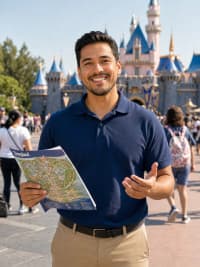
Mateo "The Map" Morales
Lead Disney Parks Specialist
Born and raised in Anaheim — Disneyland's backyard. Mateo has been riding Space Mountain since before he could tie his shoes, and he still treats the first 90 minutes of rope drop as the whole game.
From
Anaheim, CA
Parks Visited
6 Disney Parks
Specialty
Lightning Lane Strategist